In 2013, the nonprofit Center for Pet Safety (CPS), with funding from Subaru, put car harnesses marketed with "crash-tested" claims through real sled tests at an independent NHTSA-contracted lab. Of the 11 harnesses sampled, four failed the preliminary strength tests. Of the seven that went on to crash testing, only one earned top marks — the rest showed stitching or hardware problems, and one let the test dog become a full projectile.
The takeaway hasn't changed: a "crash-tested" label on the box means very little unless you know who tested it and to what standard.
Why Restraint Matters Beyond Your Dog
An unrestrained dog becomes a projectile in a collision. AAA estimates that an 80 lb dog in a 30 mph crash exerts roughly 2,400 lbs of force — the exact number depends on the crash, but the danger to the dog and to every person in the car is real. A loose dog is also a driving distraction long before any crash happens.
Crash-Test Results Compared
| Harness | Crash test | Max tested weight | Chest range | Seat belt attachment | Buy |
|---|---|---|---|---|---|
| Sleepypod Clickit Sport Plus | CPS Certified · 5 Star Center for Pet Safety harness protocol CPS-001-014.01 | 90 lb Size S: 25 lb | 16.5–40 in 4 sizes | Seat belt threads through two loops on the back | Check on Amazon |
| Sleepypod Clickit Range | CPS Certified · 5 Star Center for Pet Safety harness protocol CPS-001-014.01 (tested Nov 2022, 110 lb test dog) | 110 lb | 19–44 in 5 sizes | Vehicle seat belt | Check on Amazon |
| Ruffwear Load Up | Maker-tested Dynamic test under FMVSS 213 conditions at MGA Research (25, 45 and 75 lb test dogs) | 75 lb | 13–42 in 5 sizes | Single seat belt loop on the back | Check on Amazon |
| Kurgo Tru-Fit Enhanced Strength | Maker-tested Manufacturer crash test based on the FMVSS 213 child-restraint procedure | 75 lb | 12–44 in 5 sizes | 10 in tether with steel carabiner to the seat belt | Check on Amazon |
| EzyDog Drive | Maker-tested Maker states it meets FMVSS 213 (US), ECE R16 (EU) and ADR 42/04 (AU) requirements | Not published | 11–42 in 3 sizes | Seat belt through two webbing handles on top | Check on Amazon |
CPS = Center for Pet Safety, the nonprofit that runs independent crash-test certification for pet restraints. "Maker-tested" means the manufacturer reports its own crash test; it has not been certified by CPS. Specs verified October 2026 against CPS and manufacturer sources. As an Amazon Associate we earn from qualifying purchases.
Find the Right Size for Your Dog
A crash-test rating only applies when the harness fits correctly and your dog is within the weight range it was tested at. Enter your dog's chest girth and weight to see the matching size for each harness.
Measure around the widest part of the rib cage, just behind the front legs. Keep the tape snug, not tight.
Always confirm against the manufacturer's current size chart before buying. A crash-test rating only applies when the harness fits correctly and your dog is within the tested weight.
CPS-Certified: Sleepypod Clickit Sport Plus and Clickit Range
Sleepypod's Clickit harnesses hold 5-star certification from the Center for Pet Safety under its harness crash-test protocol, and they come from the same design line as the Clickit Utility, the top performer in the 2013 study. The Clickit Sport Plus is certified for dogs up to 90 lb (the small size is rated to 25 lb) and doubles as an everyday walking harness. The Clickit Range was certified with a 110 lb test dog, making it the pick for large breeds.
Manufacturer-Tested Alternatives
The Ruffwear Load Up, Kurgo Tru-Fit Enhanced Strength and EzyDog Drive have been crash-tested by their manufacturers, but not certified by CPS. They are a step above untested harnesses — just not independently verified to the same protocol. Check the maximum tested weight before you buy: both the Ruffwear and the Kurgo were tested only up to 75 lb, even though they are sold in sizes for bigger dogs.
What to Avoid
Skip extension tethers and zipline-style attachments, which let the dog travel further in a crash. Never connect a seatbelt restraint to a collar, and treat any "crash-tested" claim that doesn't name the test standard and the lab as marketing.
Harness, Crate or Carrier?
A harness isn't the only way to restrain a dog in the car, and it isn't always the best one.
- Crash-tested harness: works for most medium and large dogs on the back seat and doubles as a walking harness. Fit and the tested weight limit are everything.
- Crash-tested crate: often the best option for dogs that ride in the cargo area of an SUV, as long as the crate itself has been crash-tested and is anchored with strength-rated straps. The Center for Pet Safety has certified some crates, including models from Gunner Kennels.
- Carrier for small dogs: a seatbelt-secured carrier on the seat can be crushed in a crash unless it's been crash-tested. Without that evidence, the floor behind the front seats is generally safer for a small carrier. Sleepypod carriers are among the products CPS has certified.
Where Your Dog Should Ride
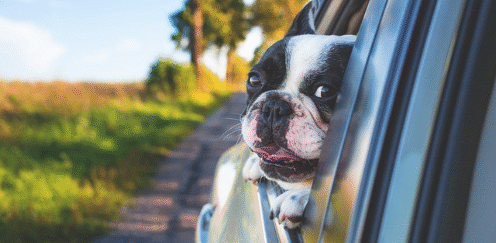
Keep dogs in the back seat or a secured crate in the cargo area, never in the front passenger seat. Front airbags deploy with great force and are designed for adult humans, not dogs. And never let a dog ride with its head out of the window or loose in a pickup bed.
How to Use a Car Harness Correctly
- Size it by chest girth and weight, not breed. Use the sizing tool above, then confirm against the maker's chart.
- Adjust it snug. You should be able to slide two fingers under the straps, but the harness shouldn't rotate or slip over the shoulders.
- Connect it the way the maker tested it. Crash results only apply to the attachment method used in the test, usually threading the seat belt through the harness. Don't add extensions or zipline tethers.
- Keep the slack short. The dog should be able to sit and lie down, but not reach the front seats or the footwell.
- Practice on short trips. Let your dog get used to the harness at home, then on short drives, building up gradually.
- Replace it after a crash, just like a child seat, even if it looks undamaged.
Frequently Asked Questions
What is the safest dog car harness?
The safest options are harnesses certified by the Center for Pet Safety, an independent nonprofit, used within the weight range they were tested at. At the time of writing, the Sleepypod Clickit Sport Plus and Clickit Range hold 5-star CPS certification.
Are "crash-tested" dog harnesses really crash-tested?
Some are, some aren't. There is no federal safety standard for pet restraints, so "crash-tested" can mean anything from independent certification to a manufacturer's own test with an unpublished result. Look for the lab, the standard and the maximum tested weight.
Can a dog wear a car harness for walks?
Many can. The Sleepypod Clickit Sport Plus, Ruffwear Load Up and Kurgo Tru-Fit are all designed for walking as well. Check that the leash attachment point suits your dog.
Is a crate safer than a harness in the car?
Only if the crate itself has been crash-tested and is properly anchored. An unsecured or flimsy crate can break apart or become a projectile in a collision. For dogs riding on the back seat, a certified harness is usually the practical choice.
Do small dogs need a car harness?
Yes, or a crash-tested carrier. Small dogs are thrown just as easily in a sudden stop. Choose a harness rated for your dog's weight or a carrier with independent crash-test evidence.
Sources: Center for Pet Safety (2013 Harness Crashworthiness Study and certification program). Tufts Your Dog, "Is Your Dog's Car Harness, Travel Crate, or Carrier Crash-Test Certified?" AAA estimate of crash forces for unrestrained pets. Manufacturer crash-test documentation for Sleepypod, Ruffwear, Kurgo and EzyDog.